

Wildfire Risk Modeling Leaders Convene to Advance Fire Risk Intelligence
More than 80 leaders from the wildfire risk intelligence community gathered June 8–9, 2026, in Palo Alto, California, for an inaugural summit to shape the future of risk modeling and its application by fire safety and mitigation practitioners. The event provided an opportunity to assess the strengths of current models, identify critical gaps, and explore development of a shared framework to improve modeling capabilities and decision-making related to both pre-fire mitigation and active-fire response operations.
The summit represented a key milestone in UL Research Institutes’ Fire Safety Research Institute’s Wildfire Risk Modeling Exercise and broader fire risk research project addressing the growing wildfire problem. Led by Principal Research Scientist Rebecca Harned, the exercise began in March through a close partnership with Gordon & Betty Moore Foundation, CAL FIRE, U.S. Department of War’s Strategic Environmental Research and Development Program, University of California San Diego’s Wildfire Science & Technology Commons, FireWERX, and Google.org.
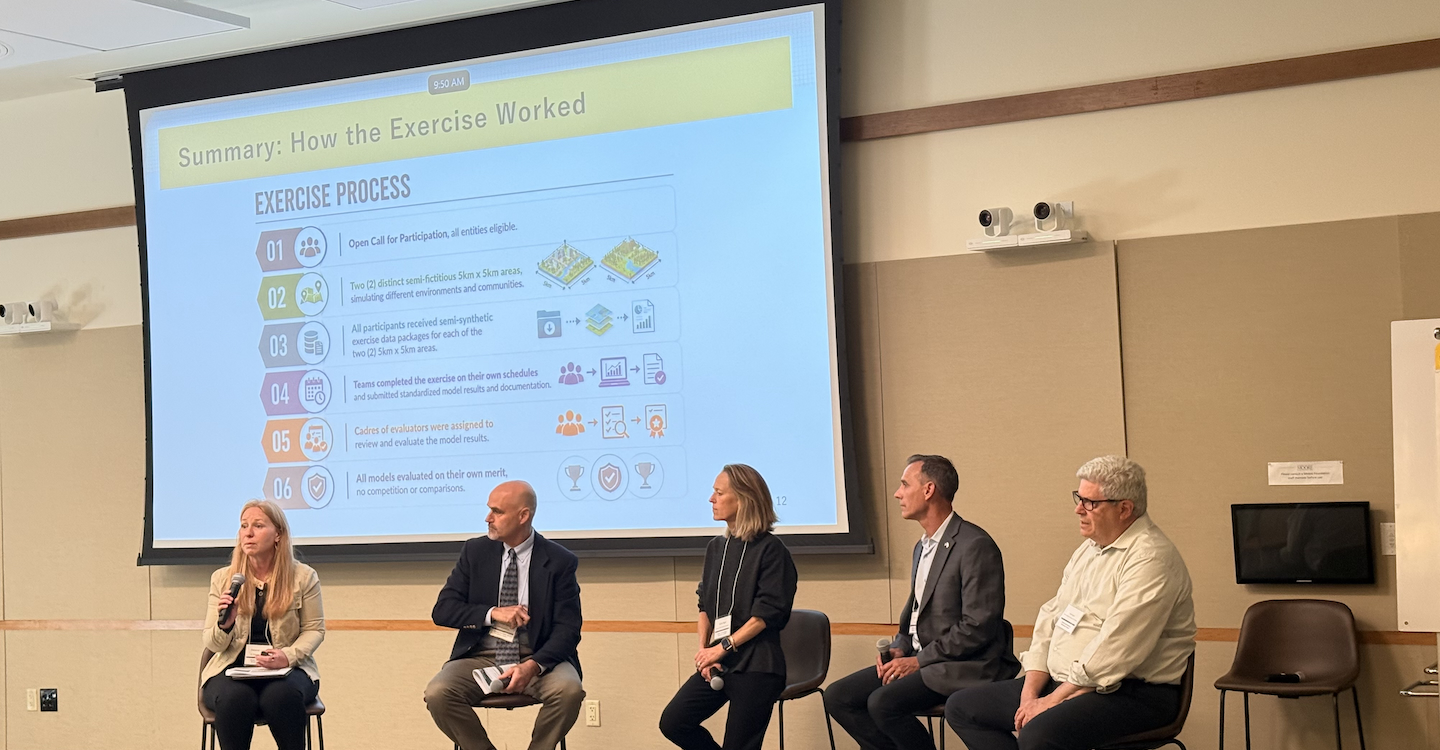
Attendees represented organizations from across the public and private sectors, including academia, government, utilities, insurance, fire service, technology, and philanthropy — underscoring a shared enthusiasm and commitment to advancing science and modeling to achieve the best possible fire risk intelligence. Exercise participants from 13 organizations presented their fire risk models while breakout sessions and panel discussions gave everyone the opportunity to be heard.
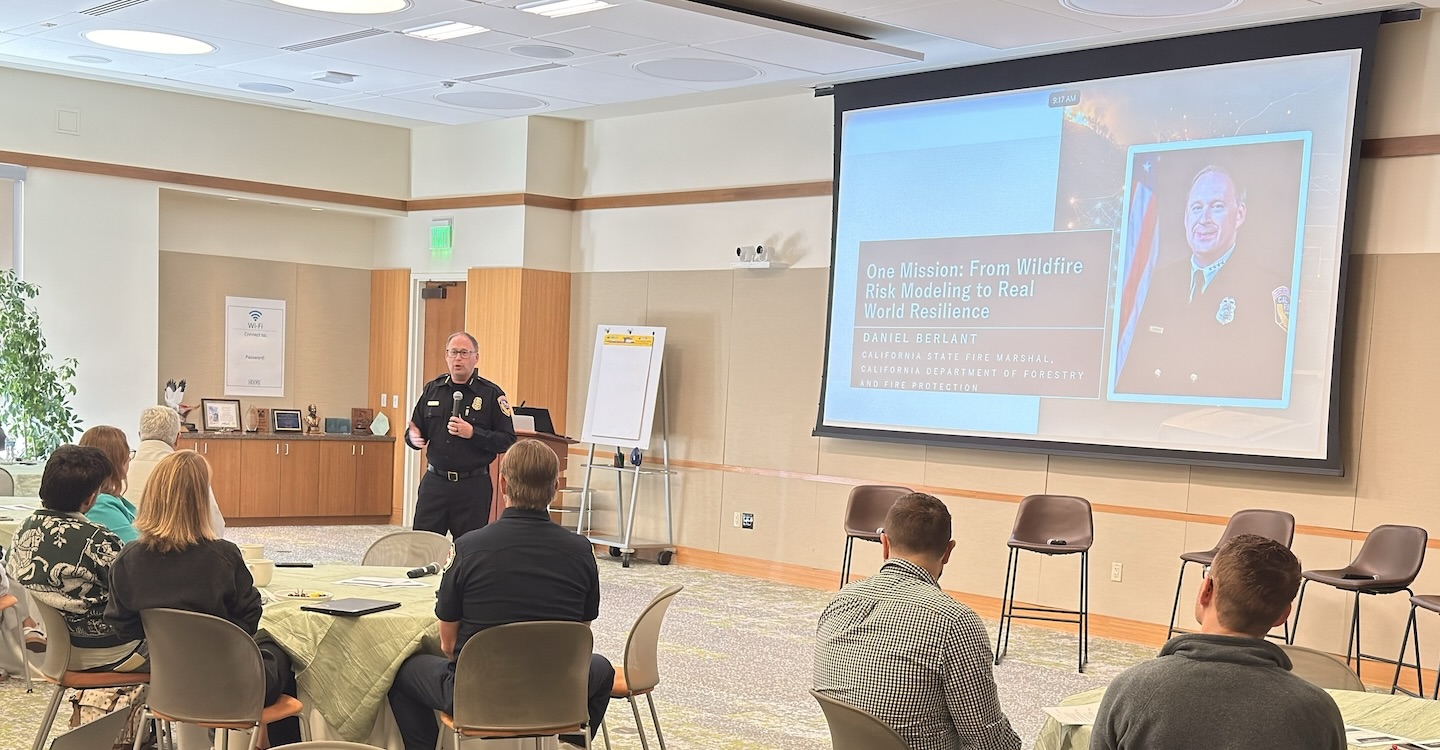
The event also featured notable keynote speakers: California State Fire Marshal Daniel Berlant, Cal OES Director Caroline Thomas Jacobs, and Michael Wara, director of the Climate and Energy Policy Program at Stanford University’s Woods Institute of the Environment.
"Together we established the relationships, shared understanding, and collective vision necessary to accelerate innovation and translate scientific advances into practical solutions that provide the wildfire risk intelligence necessary in enhancing community resilience and achieving data- and science-informed decision-making when it matters most."
— Rebecca Harned
Principal Research Scientist
UL Research Institutes | Fire Safety Research Institute
Key Takeaways from the Wildfire Risk Modeling Summit
Five important takeaways and themes emerged from the event:
1. Continued partnership and collaboration remain critical
It’s only through cooperation across industries and borders that fire risk intelligence can meaningfully advance. This means everyone at the table must have an equally important voice, from the researchers and technologists creating the models to the fire and public safety professionals who will be using them to inform their decisions.
2. Bridging the gap between data science and operational decision-making
Researchers and technologists can develop highly accurate risk models; however, their full value depends on how effectively fire service practitioners and public safety officials can interpret and apply the information to support strategic and tactical decisions.
Perspectives on models can vary, and practitioners often bring extensive experience that may offer additional context or differ from model outputs. Continued collaboration between the risk modeling community and operational stakeholders can help improve understanding, usability, and integration of these tools moving forward.
3. The need to create an interoperability framework
Before wildfire risk modeling can truly advance and scale, the community must create a shared framework that establishes common terminologies, methodology definitions, data schemas, model validation protocols, and model performance standards.
This can start with something as simple as deciding how to define fire risk. The framework also needs to be developed in a way that caters to both open and proprietary models, enabling innovation and trust across all models.
4. A focus on modularity and integration vs. creating a single master model
Many top risk models are highly specialized. Rather than diluting what makes these models unique by combining them into a single master model, the community should instead categorize models by specialization area and develop a modular framework that allows them to be easily inserted and removed. This lets models retain their strengths while still contributing to more holistic risk model insights.
Specialization areas include:
- Hazard and vulnerability modeling
- Landscape-to-community modeling
- Physics-based and AI modeling
- Mitigation and decision support modeling
- Consequence and resilience modeling
5. The next generation of wildfire risk modeling must shine in five priority areas
After a preliminary analysis of current risk models, the community identified five priority areas for improvements:
- Structure-level risk: Identifies the most vulnerable homes and neighborhoods for prioritizing fuels reduction and structural hardening investments.
- Mitigation prioritization: Guides investments where they will have the greatest impact.
- Fire spread modeling: Focusing on the physics for wildfire transition from vegetation and through the built environment.
- Operational utility: Translating results from a model into actionable intelligence that supports planning, preparedness, and response decisions.
- Scientific rigor: Transparency on the scientific methods applied and outcomes from model validation is necessary to build trust and confidence in models among the end users.
Next Steps for the Wildfire Risk Modeling Exercise and Community
These takeaways and other learnings from the event set the stage for future milestones, including an after-action review and findings report — expected to be released in late Summer 2026. This report will present official quantitative and qualitative results from the Wildfire Risk Modeling Exercise as well as analyses of existing capabilities, critical opportunities for improvement, and specific recommendations on future actions.
Beyond the report, there are plans to publish a peer-reviewed journal article co-authored by project participants and form a Community of Practice to enable sustained collaboration, coordination, and model acceleration in the coming years.
More About the Wildfire Risk Modeling Exercise
The Wildfire Risk Modeling Exercise represents the first major initiative bringing together the wildfire risk modeling community to address the growing threat of wildfires across the U.S. and other countries.
The project began in early 2026 and was born out of a struggle to consistently measure and predict wildfire risk, which is foundational for effective pre-fire planning and mitigation strategies. It became critical to understand the unique strengths of current models and how they might be ensembled to achieve even more precise risk intelligence.
Led by ULRI’s Rebecca Harned, an Exercise Conduct and Planning Team was formed, comprising fire safety experts and leaders from ULRI, Gordon & Betty Moore Foundation, CAL FIRE, U.S. Department of War’s Strategic Environmental Research and Development Program, University of California San Diego’s Wildfire Science & Technology Commons, FireWERX, and Google.org. An open call then went out to anyone interested in submitting their model, regardless of industry or location.
Once the exercise began, participants were given two sets of semi-simulated landscape datasets as control environments for their models: one representing a town of prairies and the other a town of forests. Data included information on buildings and parcels, trees, road networks, surface fuels, synoptic weather, and fire ignition points. Participants could also provide additional types of data not included in the semi-synthetic datasets.
After submission, models were evaluated from both a practitioner and a data science lens. To reinforce the project’s focus on open collaboration, models were not compared against one another or given a score but were instead evaluated on their own individual merits.
By the numbers:
- 30+ organizations participated
- 28 unique models submitted as 20 risk solutions
- 5 countries represented
- 124 evaluations conducted

