
Paper Reports on Expanding Knowledge in Understanding Fire Dynamics in Timber Buildings
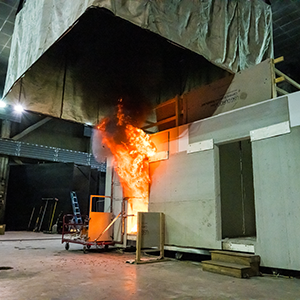
The paper “Fire Behaviour and Over-Pressure Events in Combustible Compartments” has recently been published and presented at Interflam 2025. This paper aims to expand the currently limited experimental knowledge of fire dynamics in combustible compartments, such as those in timber buildings. Key findings from this study support the Backdrafts and Smoke Explosions research project, led by UL Research Institutes' Fire Safety Research Institute. Charley Fleishmann, principal research engineer, co-authored this paper with Aatif Ali Khan, Zacharee Coventry, Samuel Curran, Harry Jones, Brad Leslie, Kayla Nuzum, and Nikunj Patel from the University of Canterbury.
Understanding Combustible Compartments Within Sustainable Design
As construction practices have recently shifted towards sustainability, more and more mass timber buildings are being constructed, marking a departure from conventional concrete and steel-frame construction. Mass timber is more sustainable because it stores carbon and requires far less energy to produce than concrete or steel. With a rise in both structural and non-structural timber applications, it is necessary to understand the benefits and risks associated with this material. While this shift towards timber offers considerable economic and environmental advantages, timber is a combustible material that can act as fuel during a fire and potentially compromise structural stability, creating serious life-safety risks to both occupants and firefighters.
Expanding Fire Dynamics Research Within Combustible Compartments
The limited availability of literature and experimental data restricts the current understanding of fire dynamics in combustible compartments. With the increasing use of combustible linings in building construction, this study addresses the gap by conducting and presenting experimental research on fire behavior in timber compartments. The findings from this study provide material-specific data, including heat release rate, temperature distributions, and observations of over-pressure events – offering valuable insights for improving the fire and life safety of buildings constructed with combustible materials.
“Much of what we know about compartment fires comes from non‑combustible enclosures, and our results suggest that when the boundaries are combustible, many of those assumptions may no longer apply.”
—Charley Fleishmann
Principal Research Engineer
UL Research Institutes | Fire Safety Research Institute
Experimental Setup
To conduct the study’s experiments, researchers constructed 11 compartments and ignited fires in each using a wooden crib ignited by a pool fire (a fire fueled by a pan of 200 ml of heptane under the crib). Three configurations of cuboid boxes with varying openings were used during the experiment: (1) a soffit above the door and (2) a full-height opening with internal joists. Both the crib and the compartment materials served as fuel sources. Temperatures were collected at 18 locations on the sidewalls throughout the compartment.
Key Takeaways
- Overpressure events were observed in compartments with the smallest openings in both box configurations.
- Video images of overpressure events can be captured on consumer video cameras and the images used to characterize the expansion of the flame.
- Larger openings led to higher HRR, while smaller openings limited the oxygen supply, resulting in lower HRR.
- Compartments with internal joists had lower temperatures than those with only soffit openings.