
Decision Support Frameworks for a Sustainable and Fire Resilient Built Environment
- Overview
As the world faces the shared challenges of slowing climate change and mitigating its effects, designers and engineers are increasingly developing sustainable buildings that reduce overall environmental impact throughout their lifecycles. These design objectives focus on delivering a high level of energy performance, sustainability, and comfort. While these designs often produce stunning structures that are environmentally responsible, healthy, and operationally efficient, there are fire safety concerns arising from unintended consequences that may only become apparent after construction. These consequences can stem from several factors — such as a limited understanding of how new technologies interact with existing building systems, variations in regulatory oversight for renovations versus new construction, different interpretations of key terminology among project stakeholders, and a lack of tools to support comprehensive risk and performance analyses.
Addressing fire safety challenges in buildings designed with a sustainability focus is inherently complex, considering the wide range of design attributes and potential risk scenarios. Meeting this challenge requires a holistic, integrated approach that considers how sustainability decisions interact with fire resilient performance across the built environment. To deepen this understanding, UL Research Institutes’ Fire Safety Research Institute is partnering with Lund University to develop a suite of Sustainable and Fire Resilient Built Environment frameworks.
Understanding the Sustainable and Fire Resilient Built Environment
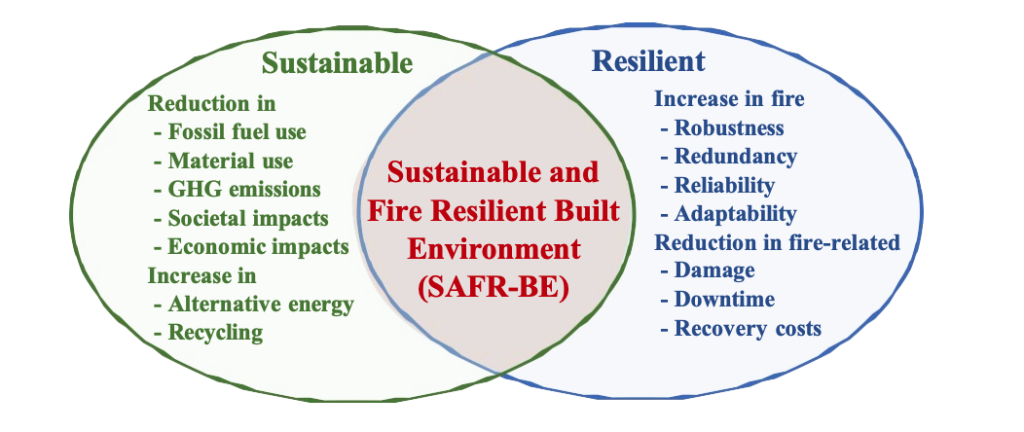
As the SAFR-BE framework is developed, it is important to understand what sustainability means in the context of building design and construction. The UN World Commission on Environment and Development defines a sustainable society as one that “meets the needs of the present without compromising the ability of future generations to meet their needs.” This is a principle of the SAFR-BE framing as applied to the built environment. The sustainability objectives of a proof-of-concept first version of this framework have been developed by investigating the two dominant green building certification schemes, LEED (U.S. developed) and BREEAM (U.K. developed), and the Whole Building Design Guide.
Complementing sustainability, resilience is broadly defined as the ability to prepare and plan for, absorb, recover from, and adapt to adverse events. In buildings, fire resilience is closely connected to long-standing fire protection strategies that prevent ignition, control its spread, mitigate its impact if it occurs, and facilitate rapid suppression. Fire safety typically aims to prevent fires or limit their spread, fostering building fire resilience. A well-known framework that illustrates these strategies is the National Fire Protection Association’s Fire Safety Concepts Tree. The FSCT outlines the key elements and interrelationships that must be considered in building fire-resilient structures, enabling designers to evaluate or plan fire protection logically and systematically. The fire resilience objectives in the SAFR-BE framing have been developed using the FSCT.
Developing a Cross-Disciplinary Foundation for SAFR-BE
To develop the SAFR-BE framework, Lund University is conducting research by bringing together researchers from two disciplines: fire safety engineering and sustainability from an architectural design perspective. The research focus within fire safety engineering characterizes fire risk and performance—both in general and in relation to sustainability-driven design attributes. This includes evaluating traditional and emerging sustainable fire safety approaches to inform the framework’s resilience objectives. In parallel, the architectural design research concentrates on identifying strategies and underlying attributes used to assess building sustainability, with consideration of how they might be impacted by fire. The outputs from this work will ultimately provide a gateway for architectural thinking on sustainable design and a connection to sustainability experts. Together, these research efforts will establish the foundation for the SAFR-BE framework.
Key Research Objectives
- Map the building design decision-making process.
- Develop the framework for different building typologies.
- Define sustainability and fire resilience with respect to the selected building typology.
- If an AHP framework is still included in the SAFR-BE frameworks, increase the reliability of importance weightings and risk estimates by expanding the breadth of expert input and by incorporating objective fire, risk, and performance data for building attributes, where available.
- Develop a decision-support tool for SAFR-BE designs to facilitate sustainable, fire-resilient design decisions.
“There is a clear and pressing need for a framework (or perhaps several) for building stakeholders to ensure that future buildings are both fire resilient and sustainable. The SAFR-BE project aims to develop and apply such a framework to building design and assessment.”
—Margaret McNamee
Professor and Deputy Dean
Lund University
This project builds on the previous work of developing a sustainable and fire resilient buildings framework. In this iteration, it maintains a focus on expanding expert input and understanding of the framework, improving both fire safety and sustainability strategies to explore all dimensions of sustainability and more importantly, understanding the interactions between sustainability and safety.

Published: May 11, 2026
Stay Informed
Get instant updates about this project as they become available.