
Updated Firefighting Search & Rescue Training: New Research Drives Strategies and Tactics
The fire service doesn’t control every factor that contributes to fire deaths — but they do own some of the most critical ones. From the moment crews arrive on scene, they go from controlling almost none of the variables to controlling nearly all of them. Those minutes matter. The decisions made during that window can dramatically influence occupant survivability and firefighter safety.
To help departments maximize those critical moments, UL Research Institutes’ Fire Safety Research Institute has released an updated version of its free Search and Rescue Tactics in Single-Family Single-Story Residential Structures course on the Fire Safety Academy. The new version now reflects the latest research findings and tactical considerations grounded in full‑scale, full‑burn experiments.
What’s New in the Updated Firefighting Search & Rescue Training
Three New Tactical Considerations
This update builds on the original Search & Rescue course, which translates fire safety research into practical strategies and tactics for single‑story, single‑family residential structures. With the release of the latest technical report, three new TCs have been added, bringing the total to 12. The course has been updated to reflect this newest analysis, developed in close collaboration with a fire service technical panel to ensure the findings align with real‑world operations and decision‑making.
The updated course now includes a dedicated lesson for each of the three new TCs:
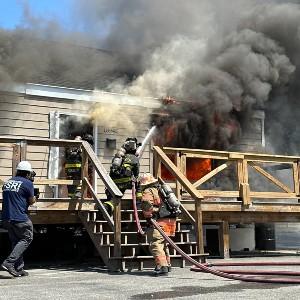
- Provided sufficient resources, upon arrival of a fully developed fire with extension to the exterior, consider conducting simultaneous execution of exterior and interior suppression operations. Lesson focus: Explain how simultaneous interior and exterior suppression can improve conditions in post-flashover environments.
- Consider locally ventilating compartments remote from the fire area as soon as possible. Pre‑suppression, this would include isolation of the compartment prior to ventilation. Lesson focus: Describe why spaces remote from the fire still require ventilation before and after suppression to keep conditions survivable for potentially trapped occupants.
- Immediately post‑suppression, consider conducting hydraulic ventilation to increase the rate at which combustion gases exhaust from the structure. Lesson focus: Explain how hydraulic ventilation improves the removal of residual combustion gases after suppression, and how its effectiveness increases when coordinated with horizontal ventilation or when multiple hoselines are used.
Each of these lessons connects fire dynamics directly to search, suppression, and ventilation outcomes, helping crews understand not just what to do but also why it matters.
New Supplemental Resources for Training Officers and Instructors
For training officers and instructors, the updated course includes ready‑to‑implement materials designed to strengthen organizational training and close tactical gaps.
- Scenario‑Based Drill Sheets: Five drill sheets reinforce decision‑making and coordination across search scenarios and victim removal, with clear objectives, safety reminders, and adaptable variables such as visibility, fire location, and occupancy status.
- Time-to-Task Sheets: A simple tracking tool to measure how long crews take to complete key actions — forcing entry, single-room search, and drag-and-carry. Compare drag-and-carry results to fire service-developed benchmarks to identify training and staffing opportunities.
- Continuing the Conversation Guides: A set of discussion guides with reflection questions designed to spark conversation after drills or at the kitchen table, helping reinforce learning and improve retention.
“This updated course helps firefighters understand how search, suppression, ventilation, and removal decisions interact so they can make better decisions for both occupants and crews.”
—Madi Michael
Senior Training and Education Specialist
UL Research Institutes | Fire Safety Research Institute
Take the Updated Firefighting Search & Rescue Training
Whether you completed the original course or are seeing it for the first time, the free firefighter Search & Rescue course sharpens decision‑making during the most critical minutes of a residential fire. Explore the new TCs, download the instructor resources, and help your department maximize the time that matters most.