
New Paper Reports on a New Method for Determining the Reference Heat Flux for the Spyro Approach in Fire Dynamics Simulator
The paper “High Resolution Predictions of the Sample Heat Flux During a Cone Calorimeter Test” has recently been published and presented at Interflam 2025. Key findings from this study support the Fire Modeling Development and Validation project, led by UL Research Institutes’ Fire Safety Research Institute. Jason Floyd, principal research engineer, co-authored this paper with Jonathan Hodges, lead research engineer, and previously with Jensen Hughes.
Prescribed Fires vs. Developing Predicted Fires
In computer fire modeling, most models typically rely on prescribed fires rather than predicted fires. Predicting fires in models requires understanding the complex interactions of gas-phase combustion, heat transfer into and out of a combustible material, and the chemical and transport processes within a material as it pyrolyzes. If the models are limited to the condensed phase, pyrolysis modeling involves heat transfer in the material, condensed-phase chemical reactions, the possible transport of pyrolysis products, and the diffusion of gases into and out of the material. To successfully do this, a significant amount of data on material properties and reactions is required. While the fire safety community has made significant progress in quantifying material and reaction properties in recent years, this work remains ongoing and requires substantial effort, expertise, and specialized test equipment.
Two Predictive Approaches to Modeling
Predictive approaches can be grouped into one of two basic categories:
- Modeling small-scale processes and transport phenomena within the solid.
- Defining an ignition criterion. Once that is met, a specific burning rate, often determined by testing (e.g., a cone calorimeter), is applied.
Modeling Small-Scale Processes and Transport Phenomena Within the Solid
The first category typically uses Arrhenius-type kinetics to describe the decomposition of the condensed-phase materials:
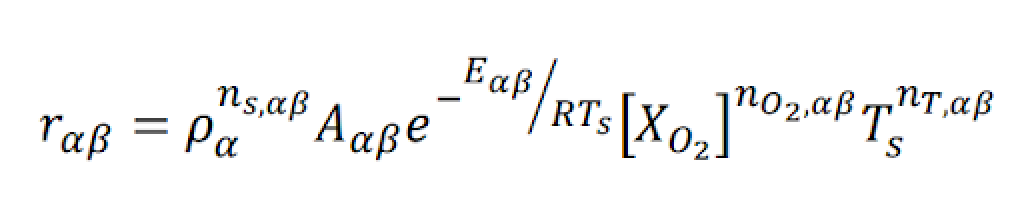
Where 𝛼 is a material, 𝛽 is a reaction, 𝑟 is the reaction rate in kg/(m3 ·s), 𝜌 is the material density in kg/m3, 𝐴 is the activation energy (units vary), 𝐸 is the activation energy in J/mol, 𝑇𝑠 is the condensed phase temperature in K, and the various 𝑛 are reaction order exponents. This equation would typically be coupled with a solid-phase heat transfer model and evaluated at multiple points within the condensed phase. Additional equations may be solved for the diffusion of oxygen into the condensed phase and the diffusion of pyrolyzates out of the solid phase.
This approach offers a key advantage – it can fully account for a material’s thermal exposure. However, two challenges remain. The first is determining the number of reactions, their Arrhenius parameters, and the overall bulk material properties of the condensed phase. While optimization approaches exist to determine these properties, substantial effort is still required to quantify them. Another challenge is that this approach fully couples the reaction rate to the prediction of heat feedback. Errors in heat feedback predictions, the reaction scheme, and material properties can combine multiplicatively. This approach can be challenging to apply outside of research applications of fire models.
Defining an Ignition Criterion
For the second category, the approaches can be object-based or cell-based. Object-based approaches can be used for hand calculations, zone models, or field models. In an object-based approach, when the ignition criterion is reached, the entire object is ignited, and heat release rate data from a test of the same or a similar object is specified. In a cell-based approach (limited to field models), the ignition criterion is evaluated on a grid cell-by-grid cell basis. When a cell ignites, the burning rate follows prescribed heat release rate (HRR) per unit area data often obtained from a cone calorimeter test. A key advantage of this category is the relative simplicity of the required inputs compared to the fully predictive approach. However, there are two main challenges:
- The availability of HRR data for a specific combustible being modeled. In the object-based approach, testing large-scale objects can be costly and time consuming.
- Testing usually occurs as a single item burning in an open condition, without a hot gas layer or nearby burning items providing additional heating.
A recent addition to Fire Dynamics Simulator (FDS) targeted the second challenge. It is an approach that dynamically scales test data from one or more cone calorimeter tests based on the FDS-predicted heat flux at the burning surface, called Spyro. This approach relies on comparing the FDS-predicted heat flux at the burning surface with the observed heat flux during the cone tests, scaling the test data accordingly.
In a cone calorimeter test, the heat flux to the surface — the reference flux (𝑞̇𝑟𝑒𝑓 ′′) — is time dependent and combines the flame heat flux (𝑞̇𝑓𝑙𝑎𝑚𝑒′′ ) with the portion (1 − Γ) of the cone heater radiant flux (𝑞̇𝑐𝑜𝑛𝑒 ′′) that passes unabsorbed through the flame.

Because measuring the reference flux is challenging, it is necessary to determine whether a reference heat flux is required. Several studies have attempted to measure the heat flux of samples during cone calorimeter experiments; however, these measurements are not straightforward to interpret and thus have some notable limitations:
- None of the prior studies measured the average heat feedback to the entire sample.
- Only a limited number of materials were measured.
- None of the cone tests attempted to account for the fraction of the cone exposure absorbed by the sample.
With relatively few tests at a handful of discrete cone exposures, the range of burning rate conditions is limited. For maximum usefulness, a semi-empirical model such as Spyro should be applicable to as many burning materials as possible. The larger the range of materials for which 𝑞̇𝑟𝑒𝑓 ′′ is known, the more broadly applicable the model will be. Attempting to build a generic, wide-ranging database of 𝑞̇𝑟𝑒𝑓 ′′ from test data that accounted for the range of potential fuel inputs and burning rates in FDS would have been very challenging and time consuming. During the initial development of Spyro, the first approach to defining the 𝑞̇𝑟𝑒𝑓′′ was empirical, estimating the flame heat flux. This approach did not account for in-flame absorption of cone radiant flux and did not easily account for differences in the flame due to fuel heat of combustion and soot yield. In a recent update to Spyro, a new approach was developed to determine 𝑞̇𝑟𝑒𝑓′′ via FDS simulations.
“This new approach to determining the reference flux during a cone calorimeter test will make the Spyro method much easier for FDS users to apply when predicting fire growth and spread.”
—Jason Floyd
Principal Research Engineer
UL Research Institutes | Fire Safety Research Institute
To view the details of this work, read the full paper: