
Kindling Completes Community-Led Fire Risk Assessment
What if the place that teaches you the most about fire risk is the one where your engineering tools are pushed to their limits?
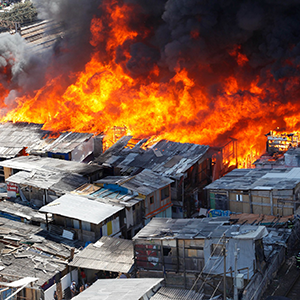
That’s exactly what happens in informal settlements, where the barriers to fire safety aren’t just technical but social, political, and economic. Fire risk isn’t only a product of physics; it’s shaped by human context and the realities that dictate how people build, live, and protect themselves.
The non-profit organization Kindling works in Khayelitsha, an informal settlement in Cape Town, South Africa. Together, they are demonstrating that effective fire risk assessments in informal settlements require more than engineering models — they rely on the insight from residents, fire services, disaster managers, and social scientists to capture the full picture.
Technical approaches often fall short because they focus on a silver-bullet solution or deliver instructions without explaining why they matter. When recommendations don’t fit people’s daily realities, they won’t stick. Kindling’s community‑led process demonstrates that when fire risk reduction is built collaboratively and grounded in lived experience, the strategies become more realistic, adaptable, and long-lasting.
Three-Phased Approach to Community-Led Fire Risk Assessment and Fire Risk Reduction
Phase 1: Inquiry
Kindling began by listening. Recurring workshops with 60—100 residents revealed the community’s experiences, priorities, and understanding of the fire problem. This feedback gave Kindling the critical background for a partnership that’s strong, productive, and grounded in trust. Through this process, Kindling developed a better understanding of the community — its demographics, crime rates, unemployment rates, and other pressures — to understand how fire risk fits into a reality where issues like food insecurity and gender‑based violence often feel more urgent. Guidance from locally recruited community-based researchers and an advisory committee was essential for both cultural grounding and community trust.
“Nothing in Kindling is prescriptive. They never came with manuals; they came with just blank papers and questions. … They were very intentional about learning from the residents’ experiences.”
—Nikelwa Maqula
Community Facilitator Coordinator
Development Action Group
Phase 2: Participatory Fire Risk Assessment
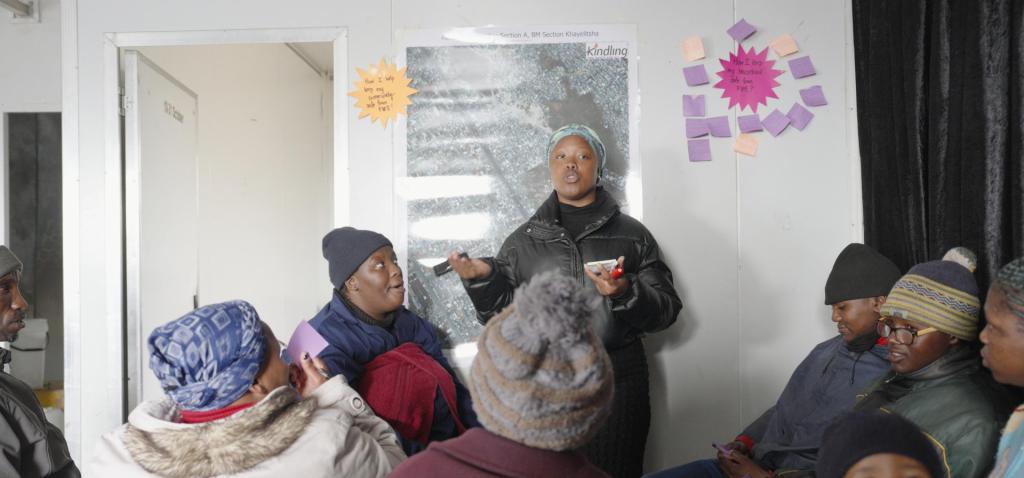
Over eight weeks, residents and Kindling mapped fire hazards, vulnerabilities, assets, and daily routines, using weekend sessions to ensure marginalized residents had meaningful opportunities to participate. As the residents primarily spoke IsiXhosa, Kindling conducted sessions in their native language, with Kindling prioritizing translation afterward that preserved residents’ lived experiences and descriptions of risk, ensuring critical information about hazards was not diluted or misrepresented. Mapping exercises became a major learning opportunity: while residents initially lacked mapping skills, with coaching, they ultimately created a “fire memory map” that showed how incomplete formal fire data and documentation were without community input.
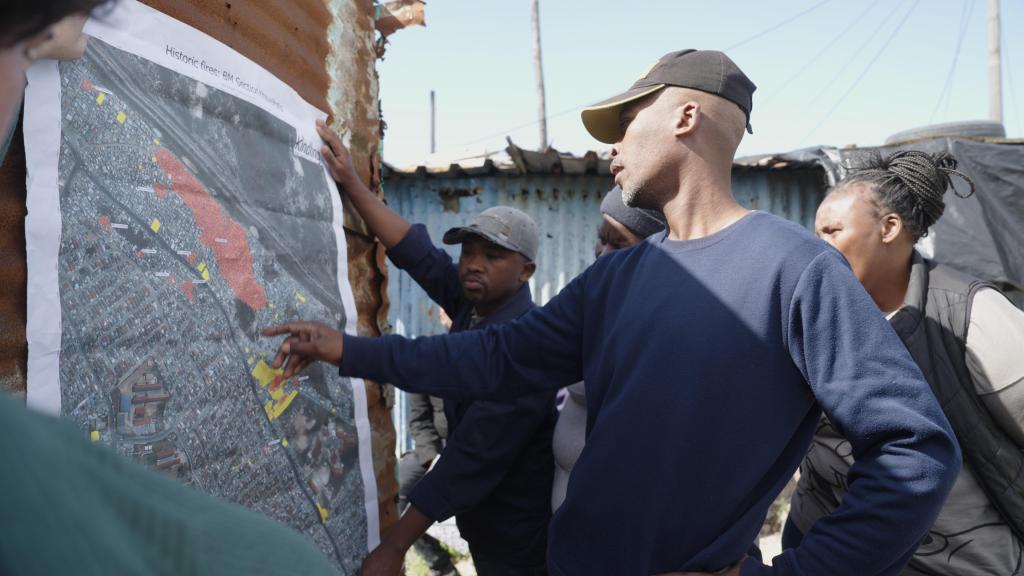
The community collectively generated 33 problem statements across six categories — ranging from ignition, spread, and fire service response, to high‑stakes decision‑making during a fire, when residents must act in seconds. Should they attempt to rescue or evacuate? Should they try to collect important documents or pick up their child at daycare, which sits in the path of the fire? Help a neighbor or fight the fire? These decision-making challenges illuminated that standard engineering principles, such as “never re‑enter a structure,” don’t fully account for the complex decisions people face in these moments.
Phase 3: Fire Risk Reduction Planning
Residents prioritized the list of problem statements and explored social, physical, disciplinary, education, and advocacy-based solutions. Some strategies — especially disciplinary measures — had to be ruled out due to risks of retaliation. These realities helped narrow the focus to a set of strategies the community could safely pursue and areas where outside advocacy may be necessary.
One clear priority was a vacant portion of land next to the community, where unmanaged waste had repeatedly sparked fires that spread to nearby homes. Residents stepped up to lead a cleanup effort, working with local government partners to reduce ignition risk and showing how an issue identified through the fire risk assessment moved from planning into real action.
Key Fire Risk Reduction Lessons for Fire Engineers
Ultimately, the biggest gap wasn’t awareness of fire’s consequences — the community has lived through devastation that most engineers only study — it was the link between everyday practices and ignition risk. Once the community learned, for example, how batteries can cause fires even when no one is present, residents recognized that many fires were preventable and that part of the power to reduce risk was in their hands. The project strengthened community relationships, built trust, and showed that effective fire risk reduction comes from meeting people where they are — not where experts think they should be — and creating space for them to grow and challenge their own beliefs on their terms.
Fire safety cannot be approached solely through a Western engineering lens. It is a political, social, and economic problem that manifests as a technical problem, meaning technical solutions alone are insufficient. For fire engineers, this requires recognizing human behavior, decision-making constraints, and response trade-offs as integral elements of the fire safety system, and designing solutions that perform under those conditions, rather than idealized ones.
At a local level, we can begin by asking our own communities: Who is most affected by fire? Who is disadvantaged when it comes to fire safety? How can we engage and listen rather than prescribe?
Outside of our neighborhood, this takes more time — in Kindling’s case, two years — and its value often only becomes clear in moments that demand action. While the original scope of Kindling’s work ended with a fire risk reduction plan, residents asked Kindling to stay on to help them build confidence in putting ideas and plans into practice and help them believe they could make a difference. Kindling stayed long enough for the work to move from planning to practice.
That learning was put to the test when a fire started in the community. Neighbors recognized the impending risk of spreading to adjacent dwellings. As some residents were about to pull off metal sheet panel walls in an attempt to ventilate and reduce fire spread, those who had participated in the workshops with Kindling were adamantly opposed, thanks to their new understanding that doing so would increase fire spread. They successfully halted the plans and later felt ecstatic, not only because the fire was contained but also because they had made a difference by applying what they had learned.
It isn’t practical to embed a fire engineer in every community to achieve the lasting effects. But investing in organizations that build local knowledge, confidence, and decision‑making capacity, as UL Research Institutes’ Fire Safety Research Institute has done through its investment in Kindling, offers a path towards fire safety for all.