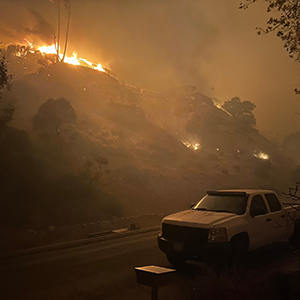

Journal Articles Investigate Water System Contamination After Wildfires
The peer-reviewed journal articles “Assessing Water Quality Impacts of Wildfire-Induced Depressurization in Water Systems: An Experimental Method” and “Assessing Water Quality Impacts of Wildfire-Induced Depressurization in Water Systems: VOC Analysis Results” have recently been published in Fire Technology. These experiments are part of the Examining Post-Fire Water Contamination in the Wildland Urban Interface project, a collaboration with Oregon State University.
Over the past decade, communities have detected volatile organic compounds in their water distribution systems following wildfires, as a result of damage and depressurization. Together, these studies first outline a comprehensive experimental framework — developed to quantify the effects of localized (single-structure) water system depressurization as a mechanism for VOC contamination in water systems following wildfire events — and then apply that framework to gather data from a series of full-scale experimental fires.
Experimental Method
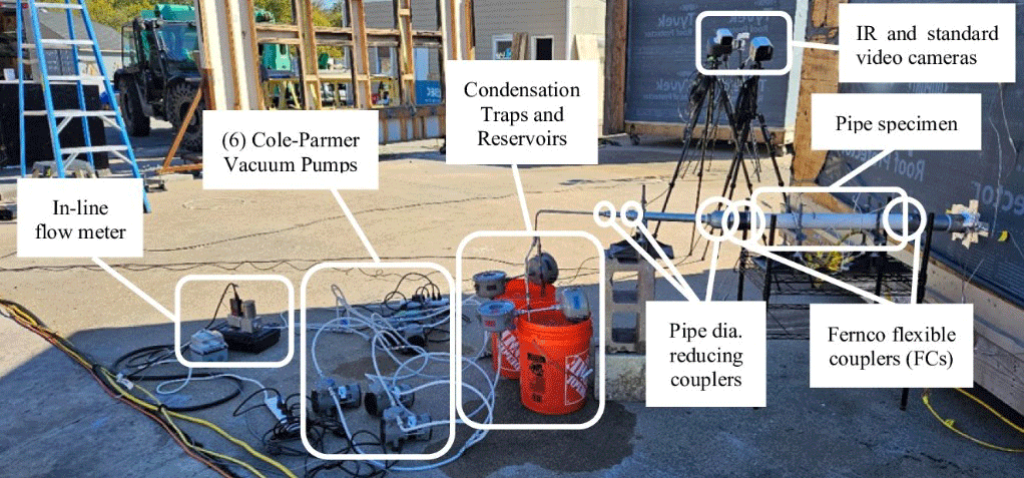
The methodology uses a modular, instrumented vacuum test setup connected to a compartment with a consistent, well-characterized fuel load. This design facilitates targeted experimentation, enabling researchers to assess specific parameters influencing VOC contamination during local depressurization. The proposed sampling protocols enable post-test measurement of system exposure to VOCs from the burning compartment and the response of system components, including levels of VOCs leached from pipes post-exposure. The setup also allows observation of how system recovery techniques may influence VOC concentrations.
VOC Analysis
Using this framework, the researchers examined high-density polyethylene, polyvinyl chloride, and galvanized steel pipes and PVC flexible pipe couplers to evaluate the role of pipe material in VOC contamination. Key findings include:
- VOCs were detected in both condensate and pipe leachate samples from all pipe materials.
- Benzene and styrene concentrations in condensate exceeded U.S. federal maximum contaminant levels in the polymer pipes, in some cases, even when no external pipe damage was visible.
- Polymer pipes generally exhibited higher VOC levels than galvanized steel, but VOC detection in steel pipes confirmed that contamination cannot be attributed solely to thermal degradation of plastics; adsorption and deposition likely contributed.
- All pipes, regardless of visible deformation, had fine black particulate matter coating the inner wall, with greater accumulation in pipes with less separation distance.
- Post-exposure flushing reduced but did not eliminate VOCs, and subsequent stagnation led to increased leaching, highlighting the risks associated with incomplete system recovery.
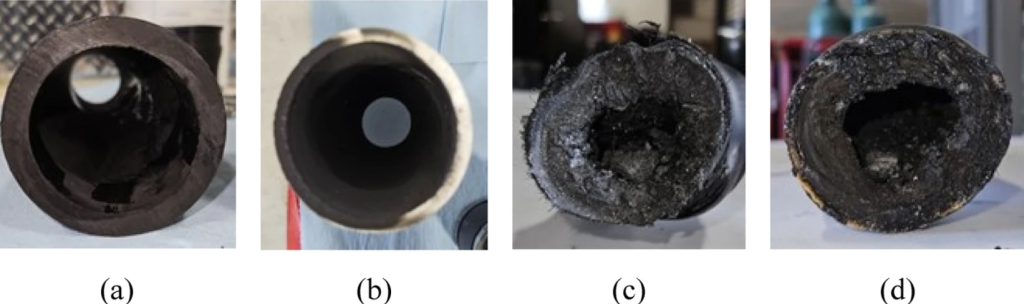
These results confirm that back siphoning of combustion gases during depressurization can contaminate water distribution systems, even when no damage is visible, and that VOCs may persist post-fire — important considerations for recovery efforts.
About the Fire Technology Journal
Fire Technology is a scientific journal that publishes original contributions, both theoretical and empirical, that contribute to the solution of problems in fire safety science and engineering. It is the leading journal in the field, publishing applied research dealing with the full range of actual and potential fire hazards facing humans and the environment. It covers the entire domain of fire safety science and engineering problems relevant in industrial, operational, cultural, and environmental applications, including modeling, testing, detection, suppression, human behavior, wildfires, structures, and risk analysis.