

Journal Article Investigates Verification of Fire Engineering Efforts to Improve Community Wildfire Resilience
Two peer-reviewed journal articles have recently been published: “Urban design and wildfire engineering at the wildland-urban interface: a review of international urban planning and building requirements” in the Australian Journal of Emergency Management and “Applying the Concept of Verification in Fire Engineering to the Wildland Urban Interface” in Fire. These papers were co-authored by Daniel Gorham, research engineer for UL Research Institutes’ Fire Safety Research Institute, in collaboration with Greg (Penney) Drummond, from Fire and Rescue New South Wales and the University of New South Wales in Australia, Greg Baker, from Halliwell Fire Research in New Zealand, Andres Valencia, from the University of Canterbury in New Zealand, and Anthony Power, from Covey Bushfire Team in Australia. This international research examines community and legislative efforts to address wildfire vulnerabilities and factors that impact the efficacy of the resulting actions.
Urban Design for Wildland Urban Interface Fire Resilience
As the world continues to face significant fire devastation, particularly in wildland-urban interface areas, experts have worked to determine the best ways for communities to enhance their preparedness. Common urban planning approaches aim to mitigate WUI fire risk by addressing community vulnerabilities through zoning, defensible space, access and egress, water supply, and building construction standards. Despite this focus, communities continue to face significant financial and human losses from wildfires worldwide, prompting an examination of the adoption and effectiveness of resilience efforts.
The first article reviewed urban design and wildfire engineering approaches to WUI urban design legislation, policy, and frameworks across multiple countries. The authors found that the adoption of urban design solutions for WUI fire resilience measures varies globally, and in some cases, conflicts exist between planning and building approaches. Australia has strict WUI building standards, but they largely lack evidence-based support beyond qualitative principles and basic heat calculations. State-level variations in Australia and the US create irregular application, while Canada and New Zealand offer only voluntary guidance. Spain, Chile, and Portugal have minimal to no mitigation measures — despite each having a significant history of wildfire events.
This study concluded that the inconsistency and qualitative judgment methods limit the potential effectiveness of the efforts to improve resilience of communities and structures in the wildland urban interface. The path forward must include the adoption of formal fire engineering approaches, combined with defined performance criteria and verification methods, to ensure an evidence-based approach.
The conclusions from this study, paired with the recent extension of WUI building code requirements in Australia to hospitals, childcare facilities, and schools — without consistent risk assessment or evaluation — led the researchers to develop and propose a verification method, presented in the second article.
Developing a Model for WUI Code Verification
There are devastating consequences from both underestimating wildfire risk and taking overly conservative approaches from safety, economic, and social standpoints. The authors outlined the Wildfire Expected Risk to Life and Property (WERLP) verification method as a holistic probabilistic approach to design assessment:
| WERLP = (I x SF)(S x SF)(E x SF)((G + NCF + DFF) x SF)(H x SF) |
|---|
|
Where:
|
The authors conducted a case study of a proposed hospital in a “bushfire-prone” area in Queensland, Australia. To calculate S, the probability of the fire reaching the urban interface, they used SPARK, an adaptable wildfire model. This model also calculated a maximum radiant heat flux for the site of 19 kW/m2, equating to an Australian Standard 3959 Bushfire Attack Level of BAL-19. This value, which decreases with distance from vegetation, determines construction requirements.
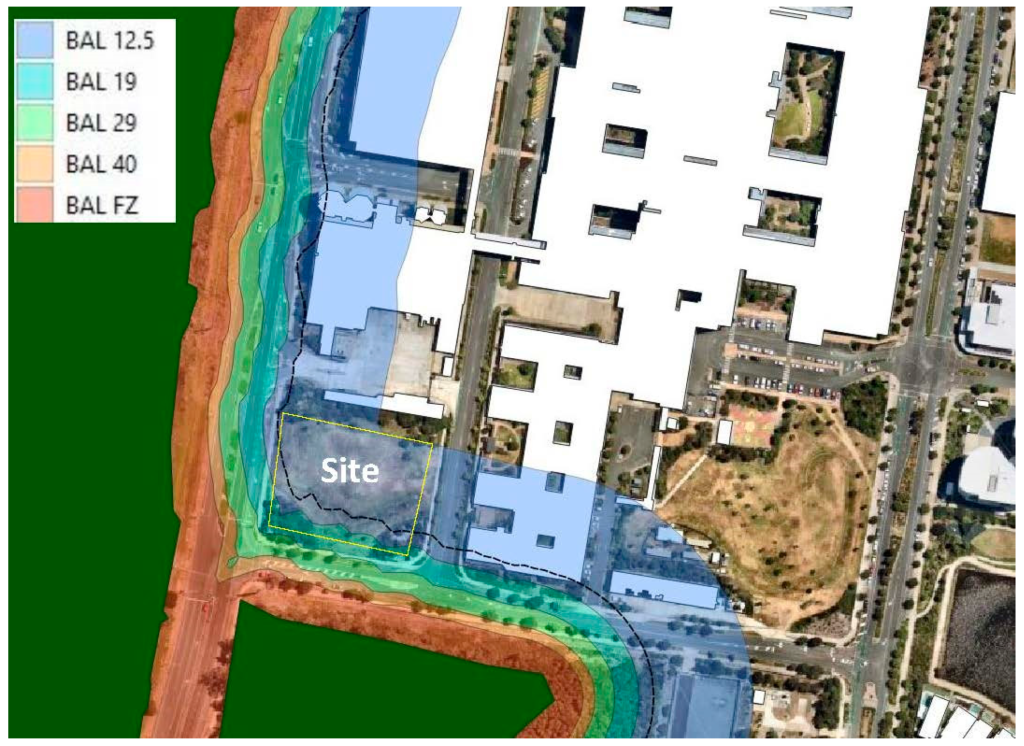
Other variables were defined using existing research, policy, datasets, and simulations. The resulting WERLP value was less than the acceptance criteria, indicating that the design was suitable from both urban design and building code perspectives.
WERLP’s reliance on existing datasets, the consideration of only one geographic point on the building site, and the required technical fire engineering knowledge are cited as limitations; however, the authors conclude it is a step in the right direction.
Read the Urban Planning Journal Article
Read the Verification Journal Article
About the Fire Journal
Fire is an international, peer-reviewed, open-access journal about the science, policy, and technology of fires and how they interact with communities and the environment, published monthly online by MDPI.
About the Australian Journal of Emergency Management
The Australian Journal of Emergency Management, part of the Australian Disaster Resilience Knowledge Hub, publishes research, reports, and relevant information related to emergency and disaster issues across society, all levels of government, community, business, and non-government sectors.

