
Journal Article Examines Impact of Residential Fire Sprinklers on E-Scooter Fires Caused by Thermal Runaway of Lithium-Ion Batteries
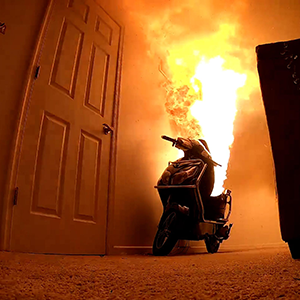
The latest peer-reviewed journal article, “Examining the Impact of Residential Fire Sprinklers on E-Scooter Fires Initiated by Thermal Runaway of lithium-ion Batteries,” has been published in Fire Technology. This study explores how full‑scale bedroom and living‑room fires escalate when an e‑scooter LiB enters thermal runaway. This study is part of the Fire Safety of Batteries and Electric Vehicles and the Examining the Fire Safety Hazards of Lithium-Ion Battery Powered e-Mobility Devices in Homes projects led by UL Research Institutes’ Fire Safety Research Institute. Authors include principal research engineer Charley Fleischmann, senior research director Dan Madrzykowski, and director of research Craig Weinschenk.
Understanding LiB Risks
LiB-powered devices have become an integral part of daily life in many parts of the world. From cell phones, laptops, e-readers, micromobility devices, and more, people use LiB-powered devices every day. However, improper use of these devices can result in physical damage, overheating, or failure of the battery management system. This can cause LiBs to overcharge or overdischarge and enter thermal runaway. Thermal runaway may result in overheating, flaming, and in some cases, explosion.
In recent years, fatal fires involving LiB-powered micromobility devices have been reported worldwide. The large number of micromobility fires and resulting casualties in urban areas is widely attributed to the large number of app-based food couriers. Based on the latest research and news reports, the trend is clear: e-scooter fires resulting in fatalities and injuries tend to occur in residential occupancies. This trend raises the question of how effectively residential fire sprinkler systems can mitigate the hazards posed by thermal runaway fires in LiB-powered e-scooters.
Experimental Setup to Examine Residential Fire Sprinkler System Effectiveness
Researchers conducted tests in a full-scale, purpose-built, ranch-style residential structure located at ULRI’s fire safety research facility in Sharon Hill, Pennsylvania. The experimental structure was divided into four bedrooms and included an open design living room, dining area, and kitchen. The experiments used a residential sprinkler system designed and installed by the National Fire Sprinkler Association to meet National Fire Protection Association 13D requirements. A sit-on, two-wheeled LiB-powered scooter was also used for each experimental setup.
Experiments were conducted in both bedrooms and the living room. In the living room scenario, the e-scooter was positioned inside the front door along the entry path between the door and the hallway leading to the bedrooms. The fuel load consisted of the e-scooter and furnishings typically found in a home. These furnishings were considered target fuels to assess whether they would ignite and whether the sprinkler water would protect them from the heat. All experiments included the LiB in a 100% state of charge, and specific tests involved the e-scooter being either overcharged or overheated.
Key Findings Show that Residential Fire Sprinklers Effectively Control Fire Hazards
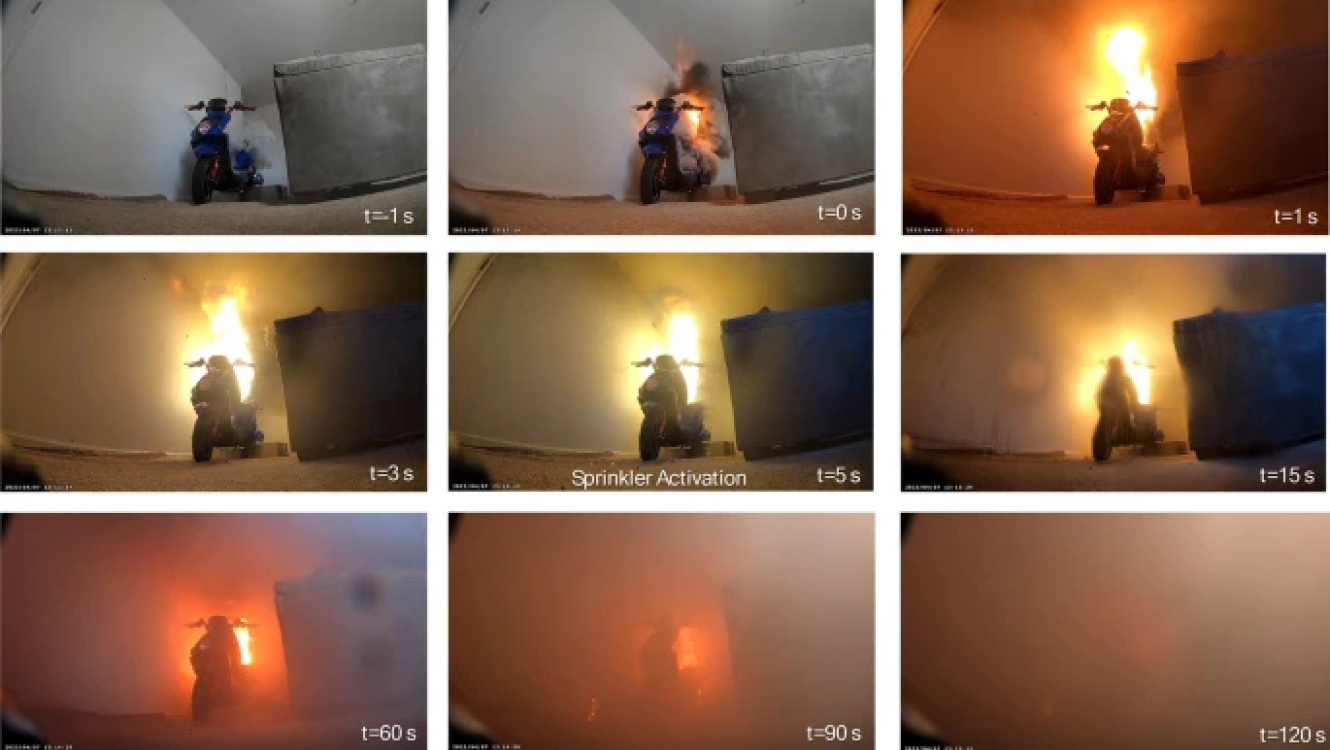
Across all experiments, the residential sprinkler system performed as expected, preventing flashover and stopping the fire from spreading to other fuels in the room after sprinkler activation. Key findings from this study demonstrate that a residential automatic fire sprinkler system, designed and installed in accordance with NFPA 13D, can effectively control the hazard posed by LiBs in a shielded battery module in a sit-on e-scooter.
“Our research makes the difference clear: Sprinklers confine an e-scooter fire to its area of origin, posing a direct threat only to those in close proximity to the fire. Without sprinklers, the fire escalates quickly — placing every occupant in danger within seconds and threatening the building soon after.”
—Charley Fleischmann
Principal Research Engineer
UL Research Institutes | Fire Safety Research Institute
For additional details regarding this study, read the full paper below.
About Fire Technology
Fire Technology is a scientific journal that publishes original contributions, both theoretical and empirical, that contribute to the solution of problems in fire safety science and engineering. It is the leading journal in the field, publishing applied research dealing with the full range of actual and potential fire hazards facing humans and the environment. It covers the entire domain of fire safety science and engineering problems relevant in industrial, operational, cultural, and environmental applications, including modeling, testing, detection, suppression, human behavior, wildfires, structures, and risk analysis.