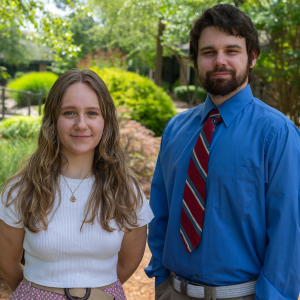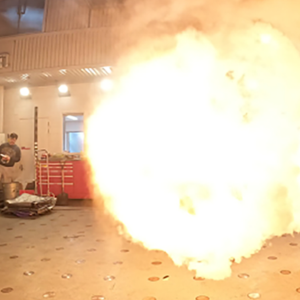

One of the first challenges of pursuing graduate research is choosing a topic among so many possibilities. Research fellow Ian Brady chose to focus his efforts on improving how researchers measure fire conditions and combustion efficiency. Ian pursued this research through the fellowship program at UL Research Institutes’ Fire Safety Research Institute, while completing his Master of Science in fire protection engineering at the University of Maryland.
How do scientists measure fire danger and predict toxic gas production during a structure fire test? One important tool is the phi meter, which is used to measure the balance of fuel and oxygen in a fire. To improve how these measurements are collected in fire experiments, Ian developed and validated a portable phi meter. Ian’s research focused on developing the phi meter for experimental sampling of compartment fires, establishing a structured framework to build an improved, portable phi meter that accurately quantifies lethal shifts in real time.
Addressing Toxic Gas Production with a Modular Phi Meter
Aiming to advance scientific knowledge of fire danger, Ian’s thesis, “Development and validation of a modular, multi-point phi meter for measurement of global equivalence ratio,” establishes guidelines for building and validating a phi meter. To ensure these measurements were accurate and practical for modern fire safety research, the study focused on three core engineering objectives: modularity, portability, and parallel multi-sample processing.
To accomplish this, the phi meter needed to process smoke samples in several stages before they could be analyzed. Beyond that, modularity and portability were essential objectives of this research. Therefore, the phi meter was designed with three primary components:
- Furnace Module (Combustion): Burned any unburned fuel in the smoke sample across four separate stainless steel lines. This module also included a high-temperature heating wire, built-in line heaters to prevent moisture buildup, and an extra oxygen supply to ensure a complete burn.
- Treatment Module (Drying): Used precise pumps to pull the smoke through the system, then applied advanced drying technology to remove all humidity before the sample was tested and measured.
- Sensing Module (Measurement): Used specialized gas sensors to measure the exact levels of O₂, CO₂, and CO, helping researchers understand how efficiently a fire is burning and how hazardous conditions may develop.
To ensure accuracy and validity in his study, Ian used a rigorous bench-scale testing system, where the new phi meter was tested by running known mixtures of fuel and air through the system. The extracted values aligned with expected ratios, demonstrating that this portable device can accurately calculate combustion efficiency under volatile conditions.
This successful result establishes an exceptional baseline for upcoming full-scale compartment fire experiments.
“I have had a fantastic time working alongside ULRI’s fire safety experts, with opportunities to work with other research engineers and gain experience with different aspects of fire safety research. The team has been great, very welcoming and encouraging, and my mentors from the University of Maryland have been wonderful as well! The fellowship was a very worthwhile experience.”
– Ian Brady
Research Fellow
UL Research Institutes | Fire Safety Research Institute
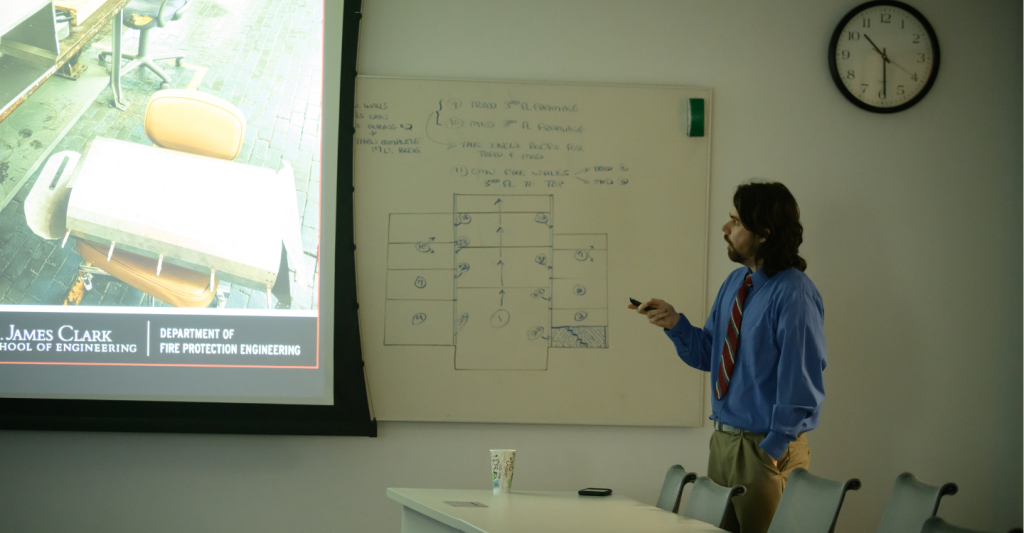
Ian’s mentors included professor Peter B. Sunderland, principal advisor from UMD; Dr. Mark B. McKinnon, research engineer at ULRI’s Fire Safety Research Institute; and Professor Stanislav I. Stoliarov from UMD. Beyond his advisors, Ian received technical assistance from John Stapko, laboratory technician at ULRI; Joseph Johnson, laboratory technician at ULRI; Les Putnam, UMD physics coordinator; and Colin Steplowski, engineering lab manager at Howard Community College.
Ian earned his Bachelor of Science in mechanical engineering and fire protection engineering from the University of Maryland in December 2023. Since completing his research fellowship, Ian has been hired as a research engineer at ULRI Fire Safety Research Institute.