
Wildland Urban Interface Fire Modeling
- Overview
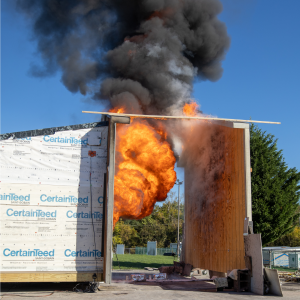
When the wildland meets the built environment, we encounter wildland-urban interface communities. These communities face unique and evolving risks, with vegetation, construction practices, and exterior combustible materials all contributing to fire spread. A critical area of WUI fire research is studying how fires spread from structure to structure — through direct flame contact, embers, or radiant heat.
To better understand the heat transfer mechanisms between structures that can ignite adjacent structures, UL Research Institutes’ Fire Safety Research Institute conducts research on Structure-to-Structure Fire Spread. Now, ULRI's fire safety experts are validating fire behavior models using full-scale experimental data, helping establish reliable tools to advance future research. These validated models have the potential to support future research, improve evacuation planning and firefighting operations, and enhance community resilience efforts in wildfire-prone regions.
Computational Fluid Dynamics Modeling
Computational Fluid Dynamics approach solves physical conservation equations using computer algorithms to predict variables that describe fluid behavior in a fire environment, including temperature, velocities, species concentrations, flame characteristics, and heat release rate.
A widely used CFD model is the Fire Dynamics Simulator, developed by the National Institute of Standards and Technology. ULRI’s Fire Safety Research Institute is proud to contribute to the ongoing success of FDS through Fire Modeling Development and Validation. FDS and other CFD models enable the fire safety community to design and analyze fire protection systems, develop training, and understand fire dynamics at both macro and micro levels.
Mitigating Risk in the WUI
Existing WUI fire spread models are limited by a clear framework to incorporate material-specific structural data or to account for structural impacts on firebrand transport and landing.
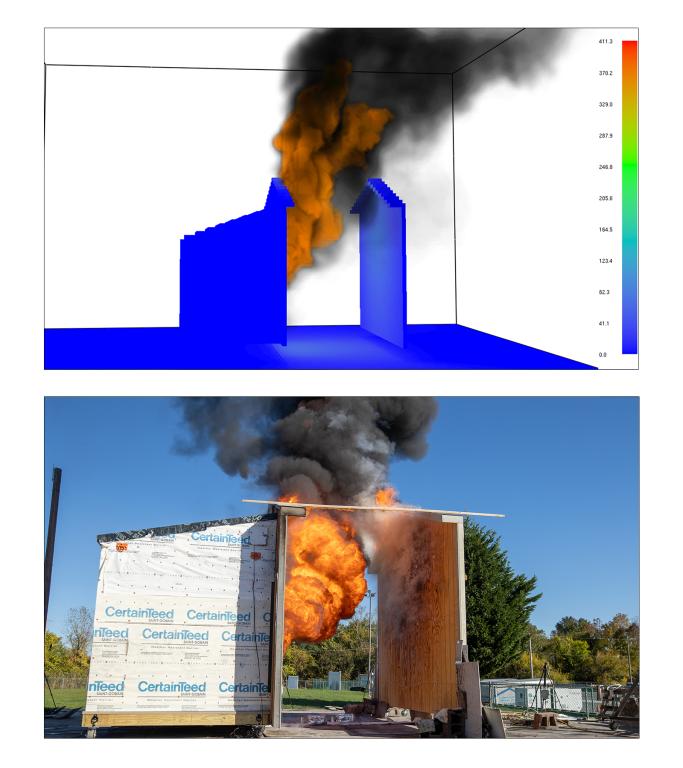
In this project, ULRI’s fire safety researchers are bridging this fire modeling gap to enable more reliable predictions. Research objectives include:
- Improve the understanding of fire dynamics in structure-to-structure fire spread using FDS and available experimental data
- Develop and validate simplified models to predict flame-imposed structure-to-structure fire spread
- Develop a modeling framework to predict the influence of structure and obstructions on ember transport, landing, and ignition potential in the wildland-urban interface
“There is a need to develop a validated modeling framework that considers the effect of material properties and performance of structural components on fire spread in WUI scenarios. Such a framework would provide a critical foundation for advancing the assessment of fire hazards and associated risks to structures through scientifically validated modeling approaches. By systematically accounting for the influence of materials and structural assemblies, we can enhance decision-making at both the community and operational levels, ultimately supporting more effective wildland urban interface fire risk mitigation and resilience planning.”
—Dushyant Chaudhari
Research Engineer
UL Research Institutes | Fire Safety Research Institute

Published: September 11, 2026
Stay Informed
Get instant updates about this project as they become available.