
Researchers Release Evidence-Based EV Battery Fire Response Considerations
UL Research Institutes’ Fire Safety Research Institute released comprehensive tactical considerations to help first responders safely and effectively manage electric vehicle fire response incidents. “Full-Scale Electric Vehicle Fire Experiments and Recommendations for Fire Incident Response” addresses critical knowledge gaps identified by fire service representatives and provides a clear operational framework with considerations for size-up, suppression management, addressing exposure hazards, and assessing battery reignition risks.
To support decision-making on the fireground, the research team worked with education experts to develop the EV Fire Tactical Decision Aid, which provides firefighters with a clear, actionable path for responding to EV fire incidents.
Evidence-Based Research Addressing Critical Fire Service Needs
This guidance is the culmination of a multi-phase research initiative examining EV battery fire safety from multiple operational angles. Working closely with a technical panel of fire service leaders and EV industry experts, researchers conducted extensive experiments to understand fire behavior, evaluate suppression effectiveness, and identify occupational hazards unique to EV fire response.
Understanding EV fire behavior and hazards
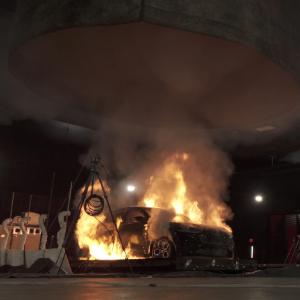
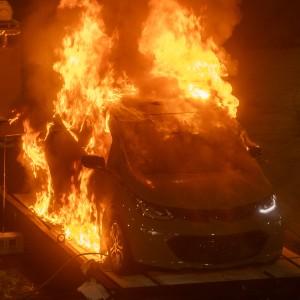
The first research phase included free-burn experiments on nine vehicles — six EVs and three ICEVs — selected from among the most popular models by U.S. sales volume, to characterize fire dynamics without intervention. Researchers induced thermal runaway in fully charged EV lithium-ion battery packs and documented fire growth rates, peak heat release, burn duration, and thermal exposure. Each vehicle typically burned out within approximately 90 minutes once ignited.
Researchers deployed both conventional and novel fire instrumentation to gather measurements related to heat release rate, heat flux, and firefighter exposure to combustion byproducts. This baseline data — collected in partnership with the National Institute for Occupational Safety and Health, Duke University, North Carolina State University, Idaho National Laboratory, and the U.S. Environmental Protection Agency — established the foundation for understanding observed differences in fire behavior and toxic gas exposures between EVs and gas-powered vehicles.
Evaluating EV fire water suppression strategies
The second research phase tested manual water suppression techniques on EV fires under realistic fireground conditions. Researchers charged EV battery packs to 100% to create severe thermal runaway scenarios, then initiated suppression seven minutes after confirmation of thermal runaway — simulating typical response and setup time. Experiments evaluated standard gas-powered vehicle tactics, direct battery pack cooling methods, and vehicle repositioning to improve water access.
Following suppression activities, battery packs were analyzed to assess stranded energy and reignition potential. Research partners from Munro & Associates conducted detailed post-test disassembly and failure analysis. Modules with remaining energy were placed in aqueous sodium bicarbonate solution to study the feasibility of discharge by extended duration soaking. All to provide firefighters with critical information about post-incident hazards.
Investigating EV fire blanket and foam suppression
The third phase evaluated fire blanket deployment without water intervention as well as with water suppression using specialized under-vehicle nozzles. Experiments on two EV models examined whether blankets could control flaming fires, slow thermal runaway propagation, and reduce smoke exposure to first responders and the public. An additional experiment evaluated water suppression with foam additives, measuring effectiveness at controlling thermal runaway and improving battery pack cooling.
Important safety finding: These experiments, and experiments conducted by the Fire Protection Research Foundation, identified a potential explosion hazard when fire blankets are used during EV fire incidents with active battery involvement, reinforcing the need for continued research on firefighting tactics.
ULRI guidance for controlling EV fires
Operational priorities at electric vehicle incidents are the same as any vehicle fire: life safety comes first. Powertrain type should never delay victim access or extrication. When the vehicle type is unknown, begin suppression — initial water application will support both rescue and fire control, regardless of vehicle type. Suppression and exposure protection should operate in parallel, with bystanders protected through evacuation or shelter-in-place as conditions require.
Water from a standard handline remains the first-choice suppression tactic — no specialized equipment is required. Firefighters should prioritize the vehicle cabin fire first, which may be necessary to identify battery involvement in the fire. The passenger compartment presents the greatest immediate fire risks and can be extinguished efficiently with water. If battery involvement is confirmed and an initial suppression effort is unsuccessful, use water as needed for exposure protection and preventing passenger compartment reignition while the battery burns out. Full structural PPE and SCBA are required throughout the incident, including overhaul, due to persistent toxic exposures and the risk of sudden reignitions, which can endanger anyone in the immediate area.
Key Operational Points
- Suppression strategy
- Use water from a handline; added suppression agents are not required
- Copious water on the vehicle and battery pack is ineffective due to vehicle construction
- If deployed, EV fire blankets should not be repositioned
- Using EV fire blankets indoors or in confined spaces can present significant deflagration risk
- Health and safety
- EV battery fires can produce elevated levels of nickel, manganese, cobalt, aluminum, copper, particulate fluoride, PAHs, and VOCs
- Approach from upwind, utilize the reach of the hose-stream, and minimize contact with debris and runoff
- Perform on-scene gross decontamination, bag contaminated PPE, and shower and launder gear back at the station
- Reignition and post-incident control
- Assume persistent reignition risk (unless the battery so clearly damaged as to be completely burned out)
- Inspect for signs of active thermal runaway, including smoke, audible cues, and increasing temperature before release
- Escort the tow truck with a suppression unit and maintain a minimum 5 m (16 ft) quarantine distance at the tow yard
Download the full report and the EV Fire Tactical Decision Aid — a step-by-step fireground decision-making tool — in our Resource Library.
"This research provides the fire service with evidence-based tactics they can implement immediately to improve firefighter safety and operations during EV fire incidents. By understanding fire behavior, exposure hazards, and the effectiveness of standard suppression strategies, fire departments can make informed tactical decisions that protect their teams and communities they serve."
—Adam Barowy
Principal Research Engineer
UL Research Institutes | Fire Safety Research Institute
While the tactical considerations and Decision Aid serve frontline firefighters, the complete experimental dataset offers valuable insights for future EV battery safety standards and regulations. The full dataset is available in Data in Brief and provides an empirical foundation for fire protection engineers and safety professionals to design new fire protection systems and evaluate whether existing fire protection systems are adequately designed to address evolving vehicle fire dynamics.
Impact and next steps
The findings and tactical considerations outlined in this report will inform the development of a comprehensive Fire Safety Academy training course to be released later this year. Beyond the training course, peer-reviewed journal articles will provide additional technical detail that can inform future research, standards development, and policy discussions surrounding EV fire safety.