
Journal Article Reports on the Development of the Anaerobic Pyrolysis Chamber
The peer-reviewed journal article “Anaerobic Pyrolysis Chamber: An atmosphere-controlled furnace for controlled-atmosphere thermal decomposition” was recently published in HardwareX. Key findings from this study support the Thermal Decomposition of Materials research project, led by UL Research Institutes’ Fire Safety Research Institute. Research engineer Ryan Chaffer coauthored this paper alongside lead research engineer Matt DiDomizio, laboratory technician Joseph Johnson, and lead research engineer Mark McKinnon.
Understanding Pyrolysis and the Need for Improved Material Testing
Pyrolysis is the process that occurs when a material undergoes thermal decomposition and, as a result, changes in physical structure and chemical composition. During pyrolysis, flammable vapors are driven off a material, and if this happens in the presence of oxygen, the vapors may ignite. Combustion can accelerate decomposition, making it difficult to isolate and extract partially decomposed material for subsequent analysis. Due to this difficulty, the thermo-physical changes to materials undergoing pyrolysis have not been extensively studied.
To address this gap, researchers designed the Anaerobic Pyrolysis Chamber as a low-cost and configurable apparatus to safely pyrolyze materials in a temperature- and atmosphere-controlled environment. It was designed to be compatible with any commercial muffle furnace with a suitable port opening.
Components of the Anaerobic Pyrolysis Chamber
The APC is comprised of four major parts:
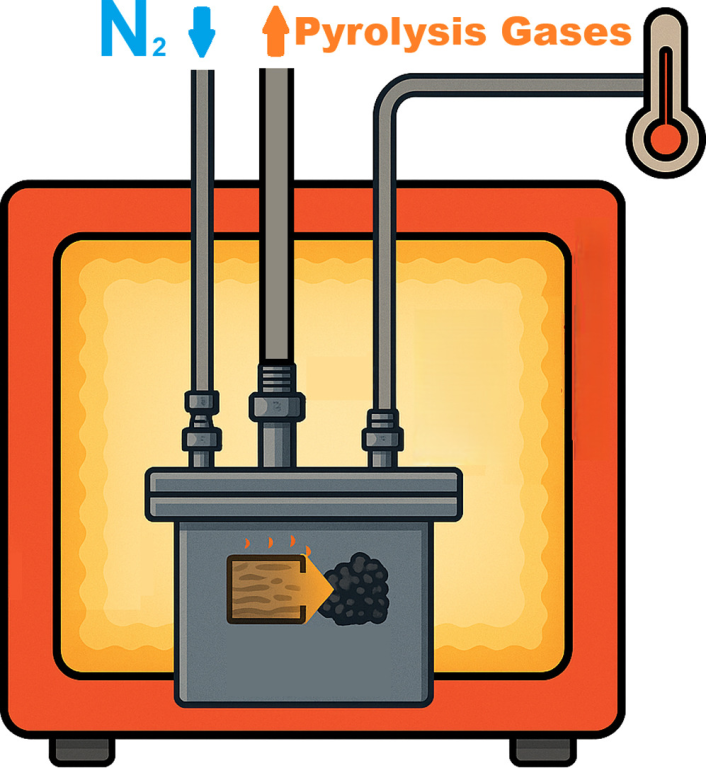
- The decomposition chamber is used to house samples during the heating process. The DC maintains a sealed, oxygen-free environment via continuous nitrogen injection throughout the heating process. The DC is positioned inside the muffle furnace, where samples may undergo pyrolysis during heating.
- The bubble vent is a pressure-control device that forces positive pressure in the DC, cools hot exhaust gases, and filters out cooled products of decomposition. Positive pressure is maintained by restricting exhaust gas flow and keeping exhaust back pressure at a minimum of five inches of water column. Constructed from off-the-shelf components, including PVC pole, polypropylene tubing, stainless steel fittings, and mesh filters, the BV is a simple, easy-to-manufacture, and effective device to promote positive pressure.
- The oxygen sensor module is a sealed chamber equipped with an electrochemical oxygen sensor and environmental sensors to measure temperature, relative humidity, and pressure within the instrument. The purpose of the OSM is to measure the oxygen concentration of the exhaust stream after it exits the DC and travels through the BV. The OSM is also the primary component used to detect leakage during the decomposition process, thereby certifying an anaerobic environment within the DC.
- The system control module controls and monitors all electrical and gas-flow components of the APC. The SCM contains an Arduino Uno, which collects and displays measurements on the built-in displays. The displays on the SCM provide an instantaneous readout of the DC temperature as well as the temperature, relative humidity, pressure, and oxygen concentration measured in the OSM.
“The Anaerobic Pyrolysis Chamber was developed to fill a void in modern bench-scale testing equipment. By creating a low-cost alternative to commercially available equipment, researchers around the world will be able to better utilize their existing infrastructure and ultimately pioneer world-changing discoveries.”
—Ryan Chaffer
Research Engineer
UL Research Institutes | Fire Safety Research Institute
The APC can deliver controlled, repeatable data that directly improves fire models and supports safer material design by helping researchers better predict ignition, flame spread, and burning behavior under real‑world fire conditions. For full details on the APC, including the design files, materials, build and operation instructions, and more, read the paper below.
About HardwareX
HardwareX is a multidisciplinary, open access, peer-reviewed journal which publishes articles that describe the design, construction, and customization of scientific devices and equipment.