
Health Risks of Lithium-Ion Battery Fires: Understanding Possible Genetic Effects of EV Fire Smoke
How dangerous is the smoke from a burning electric vehicle or gas vehicle?
UL Research Institutes’ Fire Safety Research Institute, in collaboration with the U.S. Environmental Protection Agency and the National Institute for Occupational Safety and Health, has published a new study examining the chemical compounds and mutation potential of smoke produced during electric vehicle and gas vehicle fires.
This research is part of the Fire Safety of Batteries and Electric Vehicles and Emerging Issues Related to Personal Protective Gear projects. It also builds on our previous research, which characterized the chemical components of smoke and air contamination during vehicle fires. While the previous study focused on the chemical composition of the smoke, this new research goes a step further by evaluating whether tiny solid particles in smoke — called particulate matter — can cause genetic mutations, which is an indicator of potential long-term health hazards.
Studying Vehicle Fire Safety Through Full-Scale Fire Tests
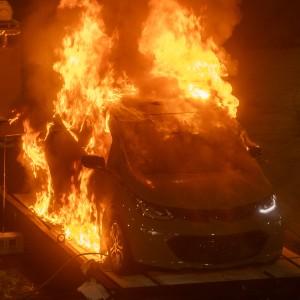
To simulate real-world conditions, researchers conducted full-scale fire tests on six EVs and two gas vehicles. They took samples of the smoke to collect the particulate matter. They then analyzed the chemical makeup of the substances and measured whether they could cause genetic mutations.
This approach enabled researchers to compare the chemical makeup and mutation potential of smoke from EV fires versus gas vehicle fires, and to benchmark these findings against other common fire types.
Vehicle Fire Safety Research Shows EV Fires Release More Hazardous Smoke Than Gas Vehicle Fires
The study revealed several important differences in the composition of smoke from EV and gas-powered vehicle fires:
- EV fires emitted 2–7 times more inorganic elements than gas vehicle fires and a significant amount of fluoride (up to 2% of total particulate mass).
- Smoke particulate from EV fires was primarily nickel, manganese, cobalt, and lithium, while gas vehicle fire smoke was mostly zinc.
- Organic compounds in EV fire smoke were more likely to cause bacterial mutations than those from gas vehicle fires.
- Both EV and gas vehicle smoke had a higher potential to cause bacterial mutation than smoke from municipal waste, residential wood, or crude oil fires.
“Electric vehicles introduce new challenges for fire safety, but the health impacts of EV fires aren’t fully understood yet. We know that both EV and gas vehicle fires produce smoke that poses serious health hazards, and this study aimed to quantify one important aspect of those hazards.”
—Richard Kesler
Research Engineer
UL Research Institutes | Fire Safety Research Institute
Understanding the chemical and biological hazards of car fire smoke, especially from EV fires, can help improve EV fire protection strategies and guide PPE recommendations for firefighters, emergency responders, and the public. These insights advance vehicle fire safety by shaping protective measures, refining PPE guidance, and informing future protocols for responding to EV fires.
About Environmental Science and Pollution Research
Environmental Science and Pollution Research serves the international community in all areas of Environmental Science and related subjects with emphasis on chemical and environmental stressors.
- Covers all areas of Environmental Science and related subjects.
- Publishes on the natural sciences, but also includes the impacts of legislation and regulation on pollution control.
- Safeguards international and interdisciplinary character through a global network of editorial board members.
- Official publication of the EuCheMS Division of Chemistry and the Environment.
- Authors from participating institutions can publish Open Choice at no cost.