
Choosing a thesis topic that bridges real-world relevance with technical rigor can shape the trajectory of an engineering career. For Olivita Hunt, research fellow at UL Research Institutes, that meant diving into the growing challenge of electric vehicle fire safety through advanced computational modeling.
As a graduate student at the University of Maryland, Olivita completed her Master of Science in fire protection engineering through the fellowship program at ULRI’s Fire Safety Research Institute. In her thesis research, Olivita focused on improving simulation practices for EV fires using the Fire Dynamics Simulator. With EV adoption accelerating, understanding how these fires behave and how to model them accurately has become increasingly important for fire protection engineers.
Advancing EV Fire Modeling Through Simulation
Olivita’s master’s thesis, “Estimating the Heat Transfer from an Electric Vehicle Fire using Fire Dynamics Simulator,” establishes structured guidelines for modeling vehicle fires in FDS and compares those models against experimental data.
The study focused on a 2020 Hyundai Kona Electric that ULRI’s fire safety team experimentally burned in February 2024. Using heat flux data, mass loss rate measurements, and video evidence from the burn, Olivita developed and tested two distinct modeling approaches:
- Multi-burner model: Simulated fire spread across multiple locations under the body, hood, cabin, and rear, capturing a more detailed representation of fire progression.
- Single-burner model: Simplified the vehicle fire into one rectangular burner representing the entire fire source.
These models were then compared to each other and to experimental results to evaluate their predictive accuracy.
Key Findings: Simplicity vs. Complexity
One of the most significant findings was that the single-burner model performed comparably to the multi-burner model when evaluating lateral heat flux– an important metric in fire safety design. This suggests that simpler models may be sufficient for certain engineering applications, offering substantial computational savings.
However, the research also identified important limitations. When analyzing heat transfer to overhead surfaces, such as ceilings, the simplified model failed to capture key temporal variations in heat flux that the multi-burner model revealed. This highlights the importance of selecting modeling approaches based on the specific design scenario.
Key takeaways include: clearly defined modeling parameters are essential for reproducibility and accuracy; simplified models can effectively predict lateral heat flux in many scenarios; complex geometries remain critical when evaluating ceiling-level or time-dependent fire behavior; and the work provides a practical framework for engineers modeling EV fires for performance-based design.
Objectives and Contributions
The research addressed several critical objectives:
- Developing a structured framework for EV fire modeling in FDS, including geometry creation, burner placement, and material/combustion parameters
- Evaluating how model complexity affects predictive accuracy
- Comparing simulation outputs to experimental heat flux data
- Identifying best practices that balance accuracy with computational efficiency
These contributions provide actionable guidance for engineers working in performance-based design, particularly when assessing fire hazards in modern vehicle scenarios.
“Arguably, the most difficult part of a master’s degree is that it’s an individual effort. However, ULRI’s fire safety experts made me feel like part of a team throughout the entire process. I could ask anyone for help, join team meetings, and contribute to broader projects. It was clear that everyone was invested in my success, and I was equally invested in the team.”
– Olivita Hunt
Research Fellow
UL Research Institutes | Fire Safety Research Institute
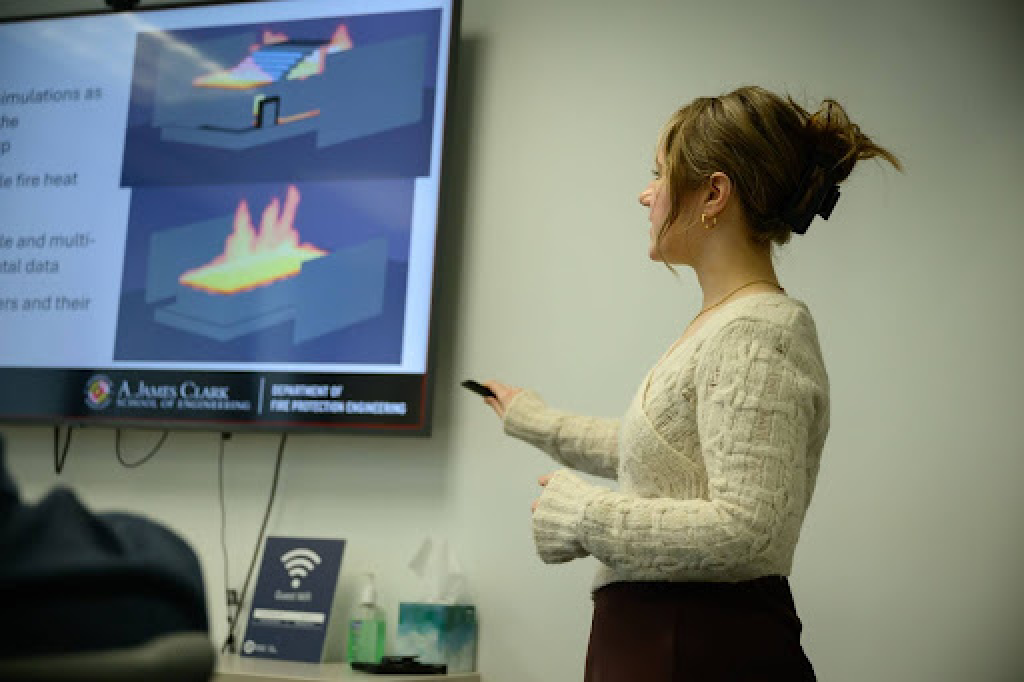
Olivita’s mentors were Adam Barowy, principal research engineer, Jonathan Hodges, lead research engineer, Arnaud Trouve, department of fire protection engineering chair at UMD, and Ali Tohidi, assistant professor at UMD. Olivita earned her Bachelor of Science in fire protection engineering from the University of Maryland in May 2024. As she wraps up her graduate studies, Olivita is looking forward to starting her career in fire protection consulting.